Introduction: Let’s Pick an Idea You Can Actually Start
If you’ve been thinking, “I want to make money online,” you’re not alone. Maybe you want a side income. Maybe you want to leave your job one day. Or maybe you just want something that’s yours.
The good news is you don’t need a fancy office, a big budget, or a million followers to begin. You can start small. Like “laptop on the kitchen table” small. The trick is choosing something simple, useful, and doable.
In this guide, I’m going to share 20 small online business ideas that you can start today, even if you’re a total beginner. I’ll explain how these businesses work, what to expect, and how to avoid the classic mistakes people make (like buying a $997 course before they’ve earned their first $9).
Ready to find your “yes, I can do that” idea?
What Is 20 Small Online Business Ideas That You Can Start Today?
It’s not one single business. It’s a list of real, small, online business options that you can start right away using skills you already have or can learn quickly.
“Small” here means:
You can start with low money
You don’t need a team
You can learn as you go
You can run it from home
“Start today” means:
You can take the first step in a few hours
You can set up a simple offer
You can reach your first potential customer fast
Some of the ideas are service-based (you help someone and get paid). Others are product-based (you create something once and sell it). A few are content-based (you build an audience and earn over time).
And yes, you can mix them. Many people do.
How Does It Work? Step-by-Step
Most small online businesses follow the same simple path. Here’s the big picture:
Pick one problem to solve
Example: “Busy people need help planning meals” or “Small businesses need better Instagram posts.”
Choose a simple offer
Example: “I’ll design 10 Instagram posts for $50” or “I’ll create a meal plan for $25.”
Set up a basic online presence
This can be a free portfolio on Google Drive, a simple Instagram page, a LinkedIn profile, or a one-page website.
Find your first customers
You can start with people you already know, local business owners, Facebook groups, or freelance websites.
Deliver the work and get feedback
Do a great job. Ask for a review. Improve your process.
Repeat, raise prices, and grow
Once you’ve got results, you can charge more, package your services, or create products.
It’s not magic. It’s mostly small steps done consistently. Kind of like brushing your teeth. Not exciting, but very effective. (And less painful than ignoring it.)
Why Beginners Should Care
Beginners often think online business is only for “experts.” That’s not true. In fact, beginners have a secret advantage: you’re willing to learn and you don’t overcomplicate everything.
Here’s why starting small online is smart:
Low risk: You can test an idea without spending much.
Flexible: You can work nights, weekends, or during naps.
Skill building: Every project makes you better.
Real options: A small side hustle can become real income over time.
Also, online businesses are based on needs. People need help writing, designing, organizing, editing, planning, selling, and learning. If you can help with one small piece, you can get paid.
What do people ask you for help with already?
Common Myths and Mistakes
Let’s clear up a few myths that slow people down.
Myth 1: You need a big audience
Nope. Many freelancers make money with a tiny audience because they sell direct services.
Myth 2: You need to be an expert
You need to be helpful, reliable, and willing to improve. That’s it.
Myth 3: You need to spend money first
Some tools cost money later, but you can start with free tools.
Myth 4: You’ll get rich fast
Online business can be great, but it’s not a lottery ticket. If someone promises “$10,000 this week with zero work,” run. Or at least walk away quickly while holding your wallet.
Common mistakes beginners make:
Trying to do 5 ideas at once
Waiting for the “perfect” time
Copying what others do without understanding why it works
Undercharging forever (or overcharging with no proof)
Not talking to customers and guessing what they want
Realistic Earning Potential: Honest Talk
Let’s keep it real. Earnings depend on your time, your offer, your skills, and your ability to sell.
Here are realistic ranges many beginners see:
First month: $0 to $300 (testing and learning)
Months 2–3: $200 to $1,000 (first steady clients)
Months 4–6: $500 to $3,000 (better offer + consistency)
After 6–12 months: $1,000 to $5,000+ (if you treat it like a business)
Some people grow faster. Some slower. Both are normal.
Service businesses often earn sooner. Content businesses (blogging, YouTube) often take longer but can grow into bigger long-term income.
The goal isn’t instant riches. The goal is steady progress and a business you can actually keep doing.
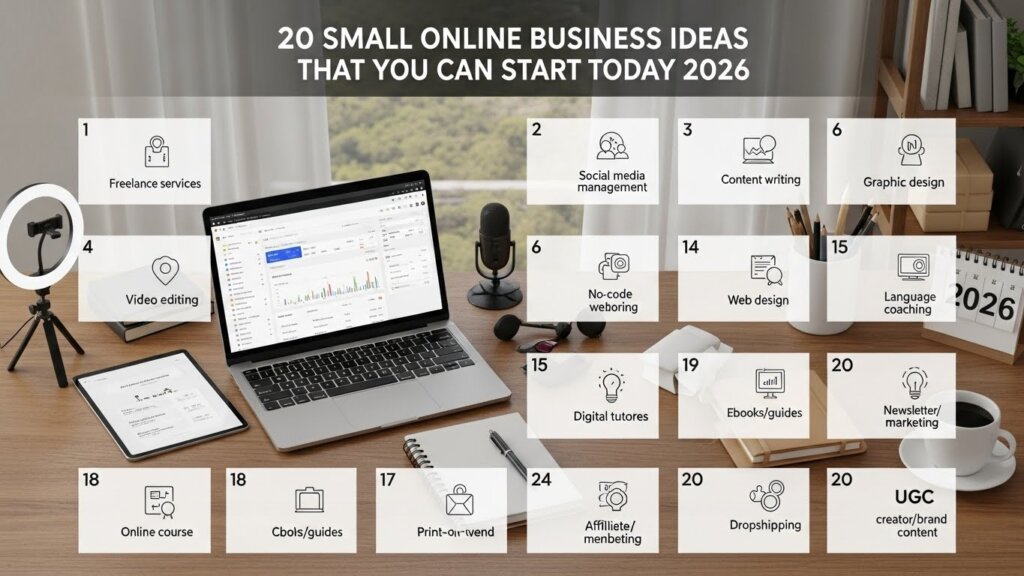
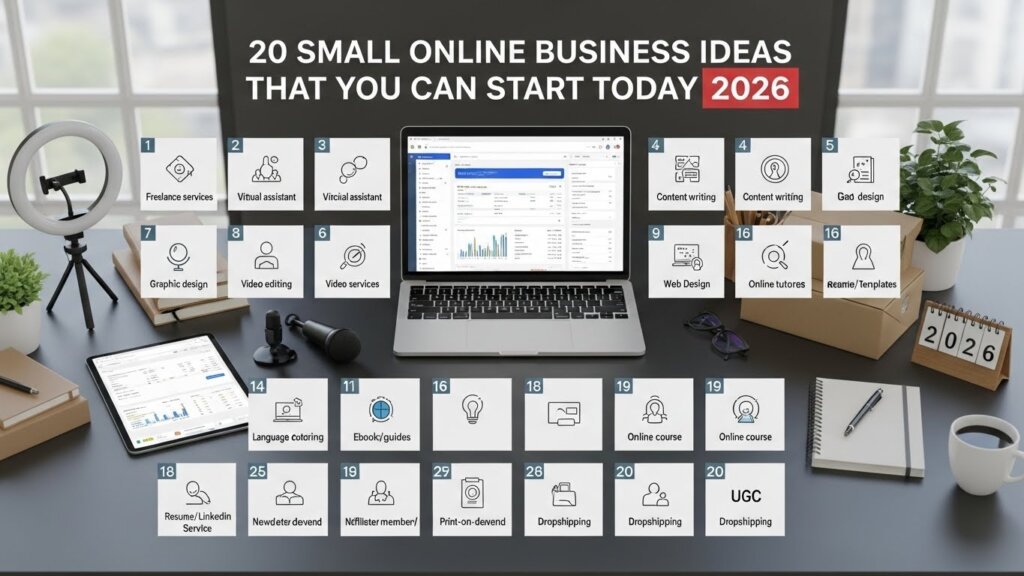
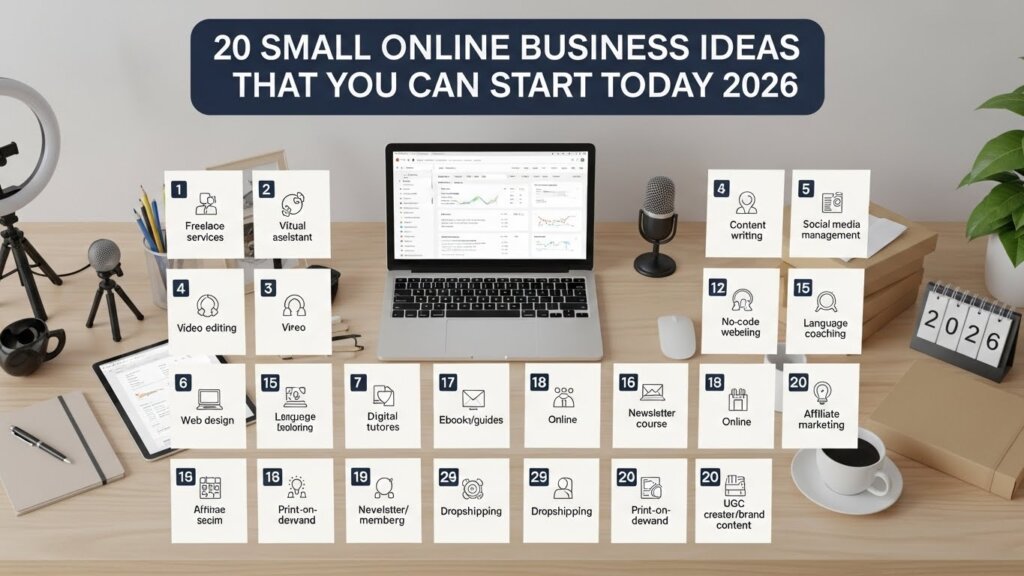
20 Small Online Business Ideas That You Can Start Today
Now the fun part. Read through these and pick one that feels realistic for you right now.
1) Freelance Writing for Blogs
If you can write clearly, you can get paid to write blog posts, product descriptions, newsletters, and more.
How you start today:
Pick a topic you know (fitness, parenting, gaming, food, travel)
Write 2 sample articles in Google Docs
Pitch small blogs or businesses
Tools:
Google Docs, Grammarly, Hemingway Editor
Real-life example:
A local dentist may pay for blog posts like “How to reduce tooth pain fast.”
2) Proofreading and Editing
Some people can write, but they make mistakes. If you’re good at spotting spelling and grammar issues, this is a solid beginner business.
How you start today:
Offer proofreading for resumes, essays, blog posts, or ebooks
Create a simple price list per page or per word
Tools:
Google Docs suggestions mode, Grammarly
3) Virtual Assistant Services
A virtual assistant (VA) helps with tasks like email, scheduling, data entry, research, posting on social media, and customer replies.
How you start today:
Make a list of tasks you can do
Offer a 5-hour starter package
Tools:
Google Workspace, Trello, Notion, Canva
Funny truth:
Half of being a VA is being organized. The other half is finding the missing login password. It’s like detective work, but with spreadsheets.
4) Social Media Content Creator for Small Businesses
Many local businesses want to post online but don’t know what to post.
How you start today:
Pick one niche: salons, gyms, restaurants, realtors
Offer 12 posts a month with captions
Tools:
Canva, CapCut, Instagram, Google Drive
5) Canva Template Seller
If you enjoy design, you can create templates for planners, resumes, Instagram posts, invitations, or business flyers and sell them.
Where to sell:
Etsy, Gumroad, Payhip, Creative Market
Tip:
Make templates for a very specific group, like “real estate Instagram templates” or “teacher planner pages.”
6) Print-on-Demand Store
You design simple graphics or slogans, and a print-on-demand company prints and ships shirts, mugs, and tote bags.
Platforms:
Printful, Printify, Redbubble, Teespring
Reality check:
This is fun, but it’s competitive. Your success depends on niche ideas and marketing.
7) Digital Planner or Printable Shop
Create printable checklists, habit trackers, budget sheets, chore charts, and sell them as instant downloads.
Good niches:
Students, moms, busy professionals, small business owners
Tools:
Canva, Google Sheets, PDF export
8) Affiliate Marketing Through a Simple Blog
You write helpful content, recommend products, and earn a commission when someone buys through your link.
How you start today:
Pick a narrow topic: “budget camping gear” or “home coffee setups”
Write one helpful article that solves a problem
Note:
Affiliate income usually takes time, but it’s a strong long-term option.
9) Start a YouTube Channel (Faceless or On-Camera)
If you like teaching or reviewing things, YouTube can become a business through ads, affiliate links, and sponsorships.
Examples:
Tutorials, study tips, simple recipes, product reviews, kids’ crafts
Tools:
Phone camera, CapCut, Canva thumbnails
10) Sell Simple Online Courses or Workshops
If you can teach one clear skill, you can sell a mini course. Keep it small and practical.
Examples:
“Canva for beginners”
“Meal prep for busy parents”
“Excel basics for office work”
Platforms:
Gumroad, Teachable, Thinkific
No need to be perfect. Students want clear steps, not movie-quality production.
11) Resume and LinkedIn Profile Help
Job seekers pay for better resumes and profiles.
How you start today:
Offer a resume refresh package
Use a simple intake form to gather info
Tools:
Google Docs templates, Canva, LinkedIn
12) Online Tutoring
If you’re good at math, English, science, or a language, tutoring is one of the fastest ways to earn online.
Platforms:
Preply, Cambly, Wyzant (availability depends on country)
Or go independent:
Teach via Zoom and take payments via PayPal.
13) Etsy Handmade or Custom Product Seller
If you make jewelry, candles, art, stickers, or crochet items, Etsy can be a strong start.
Tip:
Keep products simple at first so you can fulfill orders without stress.
14) Simple Website Setup Service
Many small businesses need a basic site. You can build simple one-page sites using WordPress, Wix, or Squarespace.
Offer idea:
“One-page website setup + contact form”
Tools:
Wix, Squarespace, WordPress, Carrd
15) SEO Content Optimization Service
Businesses have blog posts that don’t rank. You can help improve them by adding better headings, keywords, and clearer structure.
If you’re new:
Start with basic on-page SEO: titles, headings, readability, internal linking.
Tools:
Google Search Console (for site owners), Ubersuggest or similar tools, Yoast/RankMath (WordPress)
16) Pinterest Management
Pinterest is a search engine, and many blogs and shops need help creating pins and scheduling them.
Offer:
Create 30 pins per month and schedule them
Tools:
Canva, Tailwind (optional), Pinterest
17) Podcast Editing
Podcasters often need help cutting mistakes, improving audio, and adding intros.
How you start today:
Edit one sample episode (use free practice audio online if needed)
Offer per-episode pricing
Tools:
Audacity (free), Descript, GarageBand (Mac)
18) Bookkeeping for Very Small Businesses
If you’re good with numbers and organized, you can help track income and expenses. You don’t need to be a CPA to do basic bookkeeping, but you do need to be careful and honest about what you can and can’t do.
Tools:
Wave, QuickBooks, Google Sheets
Tip:
Start with simple businesses like freelancers, Etsy sellers, or local service providers.
19) Lead Generation for Local Businesses
Local businesses need customers. You can help them get leads through simple landing pages, Google Business Profile improvements, or basic ads management (only if you understand it).
Beginner version:
Help optimize Google Business Profile and collect reviews.
Tools:
Google Business Profile, Canva, Google Forms
20) Niche Newsletter
A newsletter can become a business through sponsorships, affiliate links, or selling your own products.
Examples:
“Weekly budget meals”
“Remote job leads”
“AI tools for teachers” (keep it simple and useful)
Platforms:
Beehiiv, Substack, MailerLite
Light joke, because it’s true:
Starting a newsletter is like adopting a plant. If you forget it for three weeks, it gets sad. If you show up weekly, it grows.
Step-by-Step Practical Guide to Start One Idea Today
Here’s a simple plan you can follow, even if you feel overwhelmed.
Step 1: Choose one idea for the next 30 days
Not forever. Just 30 days. Which one feels easiest to start?
Step 2: Pick a tiny niche
Instead of “social media,” choose “social media for barbers” or “social media for daycare centers.” Smaller is easier.
Step 3: Create a starter offer
Make it clear and simple.
Example: “I will write 2 blog posts (800 words each) for $80.”
Step 4: Make a basic portfolio
You don’t need a website.
Use:
A Google Drive folder with samples
A simple Notion page
A LinkedIn featured section
Step 5: Find 10 people who might need it
Local businesses
Facebook groups
LinkedIn searches
Friends of friends
Step 6: Send 10 helpful messages
Keep it friendly, not spammy.
Example message:
“Hi Sarah, I noticed your bakery’s Instagram hasn’t posted in a bit. I help small shops create easy weekly posts. Want me to send 3 post ideas for free?”
Step 7: Deliver fast and ask for a review
A short review helps you get the next client faster.
Step 8: Improve one thing each week
Better samples
Clearer pricing
Faster process
Better outreach
If you do this for 30 days, you’ll build momentum. Momentum is everything.
Tools, Platforms, and Methods That Make It Easier
You don’t need a lot, but these help.
For communication:
Gmail
Zoom or Google Meet
For organizing work:
Trello
Notion
Google Sheets
For creating content:
Canva
CapCut
Google Docs
For getting paid:
PayPal
Wise (international)
Stripe (where available)
For finding clients:
LinkedIn
Upwork and Fiverr (good for practice, but don’t rely on them forever)
Facebook groups
Local business directories
Your own network
Internal-link friendly tip for your future blog:
If you start a blog later, you can link between posts using phrases like “check my guide on how to write a great bio” or “see my list of free tools for beginners.” Google likes helpful connections.
Tips to Succeed Faster (Without Burning Out)
Focus on one skill
One strong skill beats five weak ones.
Get your first 3 customers before you perfect everything
Your business will improve more from real feedback than from endless planning.
Use simple packages
People like clear choices.
Example:
Basic: 4 posts/week
Standard: 12 posts/month
Premium: 20 posts/month + scheduling
Keep learning, but don’t drown in content
One YouTube tutorial, then take action. Don’t become a “professional watcher.”
Track what works
Where did your best leads come from? Do more of that.
Be reliable
This is underrated. Being on time and communicating well can beat pure talent.
Beginner-Friendly Mistakes to Avoid
Pricing too low and getting stuck
It’s okay to start affordable, but raise prices as you get better. Otherwise you’ll work a lot and feel exhausted.
Trying to look like a big company
You don’t need a logo, an LLC, and a 12-page website on day one. You need customers.
Skipping a clear agreement
Even a simple message that lists price, timeline, and what’s included helps avoid problems.
Not saving for taxes
If you earn income, set aside a portion. Future-you will thank you.
Quitting too early
Most online businesses feel slow at first. That’s normal. Give it a fair test.
Chasing shiny objects
Today it’s dropshipping. Tomorrow it’s “AI automation agency.” Next week it’s something else. Pick one lane and stay there for a while.
FAQs
How do I choose the best small online business idea for me?
Pick the one that matches your current skills and energy. If you like writing, start with writing or editing. If you like organizing, try virtual assistant work. If you like design, try templates. The best idea is the one you’ll actually do for 30 days.
Can I start an online business with no money?
Yes. Many service-based options can start with free tools like Google Docs, Canva (free version), and social media. You may invest later, but you can begin without paying upfront.
Which online business idea is the fastest to make money?
Usually services like virtual assistant work, tutoring, proofreading, or social media help. They can pay quickly because you’re trading time and skill for money.
Do I need a website to start?
No. A website helps later, but you can start with a LinkedIn profile, a simple portfolio folder, or a one-page Carrd site. Many beginners get clients without a full website.
How many hours per week do I need to start?
Even 5–7 hours a week can work if you focus. Use 2 hours to learn and set up, then spend the rest reaching out and doing small paid work.
Is affiliate marketing still worth it in 2026?
It can be, but it’s not instant. It works best when you create helpful content in a specific niche and earn trust. If you want faster income, start with a service first and build affiliate content on the side.
What if I’m scared to sell or message people?
That’s normal. Start small: send one message today. Offer something helpful, not pushy. Selling is really just helping the right person solve a problem.
Final Conclusion: Start Small, Start Now
You don’t need the perfect idea. You need a workable one. A simple offer. A real person to help. And the courage to begin before you feel “ready.”
Pick one from these 20 small online business ideas that you can start today and take one step in the next hour. Write your offer in one sentence. Create one sample. Message one potential customer. That’s it.
And if your brain says, “What if I fail?” ask it back: “What if I learn fast?” Because that’s how online businesses really grow—one small, honest step at a time.
If You want To start make making money online then you can check these articles:
20 AI Tools for Online Earning Beginners (Simple Guide 2026)
Real Online Earning Methods for Beginners (Safe & Practical)
How to Earn Money Online With No Skills: A Real, Beginner-Friendly Guide
How to Make $12k–$15k Per Month in 2026 With AI and Digital Products (No Skills Required)