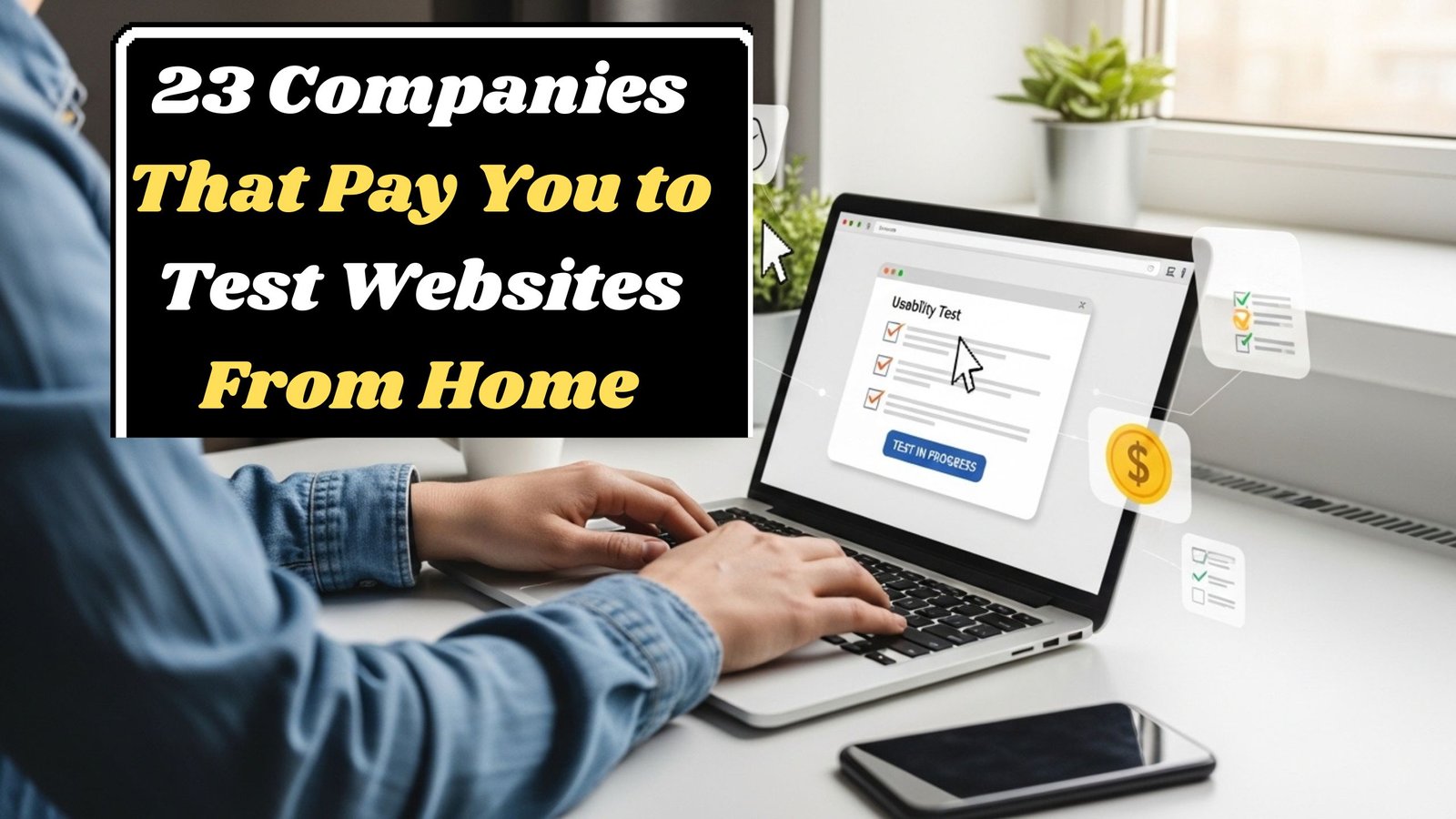
If you’ve ever clicked on a website and thought, “Why is this button hiding like it’s playing hide-and-seek?” then you already understand what website testing is about.
Companies spend a lot of money building websites and apps, but they can’t always see the problems because they’re too close to their own work. That’s where normal people (like you and me) come in. They pay you to test their site, share your thoughts, and point out what’s confusing.
And yes, you can do it from your couch. Pants are optional. Just don’t tell the webcam.
In this guide, I’m going to show you 23 companies that pay you to test websites from home, what they pay, how it works, what beginners mess up, and how you can start the smart way without getting your hopes unrealistically high.
What Is “23 Companies That Pay You to Test Websites From Home”?
The phrase “23 companies that pay you to test websites from home” is exactly what it sounds like: a list of platforms that connect testers (you) with businesses that want feedback on their websites, apps, and online tools.
You don’t need to be a coder. You don’t need a fancy degree. Most of the time, you’re getting paid to:
Notice confusing menus or pages
Try to complete a task (like buying something or signing up)
Speak your thoughts out loud while you click around
Answer a few questions after the test
Sometimes record your screen and voice
Think of it like being a “professional first-time visitor.” Businesses want to know what a real person sees when they land on the site, not what the designer hopes you’ll see.
How Website Testing Works (Step-by-Step)
Here’s the usual process across most website testing platforms. The details change a bit, but the flow is very similar.
- You sign up and create a tester profile
You’ll answer questions like your age range, country, language, job type, devices you own, and shopping habits. This helps companies find the right testers. - You take a practice test (sometimes)
Some platforms require a short sample test so they can check if your microphone is clear and your feedback makes sense. - You get invited to tests that match you
You might receive tests by email, inside the dashboard, or through an app. - You complete a task while recording
A typical task could be: “Find a pair of shoes under $50 and try to check out (don’t actually buy).” You’ll speak your thoughts out loud. - You submit your test and get paid
Payments are often through PayPal, sometimes bank transfer, and occasionally gift cards depending on the platform.
Most tests take 5–25 minutes. Some longer interviews can take 30–60 minutes and pay more.
Why Beginners Should Care (Even If You’re Not “Techy”)
Website testing is one of the easiest online side hustles to start because:
You can begin with basic skills
If you can browse the internet, you can test a website
You don’t need to build an audience like YouTube or blogging
You’re helping companies improve real products
You can do it in small pockets of time (even 10 minutes helps)
It’s also a nice “starter” online income stream. Many people use it to build confidence and then move into higher-paying digital work later (like virtual assistant work, customer support, or UX-related roles).
Let me ask you: do you already spend time online every day? If yes, turning a little of that time into paid feedback is a pretty decent upgrade.
Common Myths and Mistakes (Let’s Clear These Up)
Myth 1: “I’ll make a full-time income doing this.”
Some people do very well, but for most beginners, this is side money, not rent money. You’ll be limited by how many tests you qualify for.
Myth 2: “I need to be a developer.”
Nope. Many platforms want regular people, not experts. Your “non-tech” brain is the whole point.
Myth 3: “I should give ‘nice’ feedback so I get more tests.”
Actually, the opposite. Companies want honest feedback. If a button is confusing, say it’s confusing. Don’t worry, you won’t hurt the website’s feelings. It’s not a puppy.
Mistake 1: Talking too little during recorded tests
Most platforms require you to speak your thoughts. Silent testers often get rejected.
Mistake 2: Rushing
If you click through like you’re trying to win an Olympic speed-browsing contest, your feedback won’t be helpful.
Mistake 3: Using bad audio
If your mic sounds like you’re calling from inside a washing machine, your test may get flagged.
Realistic Earning Potential (Honest Numbers)
Let’s keep it real and useful.
Most standard unmoderated tests pay around $5 to $15 and take 10 to 25 minutes.
If you’re in a country with lots of test demand (like the US, UK, Canada, Australia, parts of Europe), and you have common devices (Windows laptop + Android or iPhone), you might qualify for several tests per week.
A realistic beginner range could be:
$20–$80 per month at first
$100–$300 per month once you’re consistent and signed up to several platforms
More if you qualify for interviews, live sessions, or specialized testing (like accessibility, bug hunting, or specific industries)
You might have weeks where you get lots of tests. Then you might have a slow week. That’s normal.
Step-by-Step Practical Guide to Start Today
If you want a simple plan that actually works, do this:
Step 1: Set up your “testing corner”
Quiet space, stable internet, working microphone. Nothing fancy.
Step 2: Create a PayPal account (if you don’t have one)
Many platforms pay through PayPal.
Step 3: Sign up for 8–12 platforms first
Don’t sign up for only one and then wonder why you’re not getting tests.
Step 4: Fill out profiles completely
The more details you provide, the more tests you match.
Step 5: Do practice tests carefully
Treat the first test like a job interview. Because it kind of is.
Step 6: Build a simple schedule
Even 20 minutes a day checking for tests can make a difference.
Step 7: Improve your feedback style
Clear, calm, specific. More on that soon.
Tools and Setup You’ll Want (Nothing Expensive)
You don’t need a studio. But you do need basics.
A laptop or desktop (many tests require it)
A smartphone (Android or iPhone helps you qualify for more)
Headphones with a mic (helps reduce background noise)
Google Chrome (commonly used)
A quiet room (or at least a quiet time of day)
Optional but helpful:
A second monitor (nice, not required)
A simple note app for quick observations
A reliable internet connection (this matters more than people think)
23 Companies That Pay You to Test Websites From Home (With Payout Details)
Below are the platforms you asked for, with beginner-friendly notes. Pay rates can change, and “varies” usually depends on the test type, length, and difficulty.
1. UserTesting.com (Usually $10 per test)
UserTesting is one of the most well-known platforms in this space. Many tests pay $10 for about 10–20 minutes of your time. They also have live interviews that can pay more.
Why beginners like it: simple dashboard and lots of opportunities in many countries
Watch out for: you must speak your thoughts clearly while recording
2. WhatUsersDo.com ($5 to $10)
WhatUsersDo offers website usability tests and sometimes app tests. Payments often land in the $5–$10 range depending on the task.
Why it’s good: beginner-friendly tasks and simple instructions
Tip: check emails quickly because spots can fill up
3. UserInput.io ($10)
UserInput commonly offers tests around the $10 mark. These are usually standard usability studies where you follow tasks and share feedback.
Why it’s useful: straightforward testing flow
Tip: complete your profile fully to match more studies
4. UserFeel.com (Around $10)
UserFeel is popular in many regions and supports multiple languages, which can help if English isn’t your first language (though many tests are in English).
Why it’s good: language variety and a clean platform
Heads-up: rating matters, so do your best on early tests
5. StartupLift.com ($5)
StartupLift tends to focus on feedback for startups and early products. Tests often pay around $5.
Why it’s worth joining: short tasks and beginner-level feedback
Reality check: not as many tests as bigger platforms, so use it as an extra
6. Analysia.com ($10)
Analysia offers usability testing tasks that often pay around $10 depending on the project.
Why it’s good: clear tasks and typical payout
Tip: treat each test like you’re helping a real person (because you are)
7. TryMyUI.com ($10)
TryMyUI is another well-known name. Many tests pay $10 and require you to record your screen and voice.
Why people like it: reliable structure and common test availability
Best practice: talk through what you’re doing and why
8. Userlytics.com ($10)
Userlytics offers website and app testing, often around $10 per session.
Why it’s solid: a steady reputation and structured tests
Tip: keep your environment quiet; audio quality is important here
9. UserCrowd.com (Varies)
UserCrowd is often quicker, with short survey-style tests. Pay varies, and tasks may be shorter than full recorded sessions.
Why it’s good: quick tasks you can do fast
Tip: don’t expect every task to be high-paying; it adds up over time
10. EnrollApp.com ($1 to $10)
Enroll sometimes offers short feedback tasks that can pay small amounts, and sometimes higher depending on the study.
Why it’s useful: easy, beginner-friendly questions
Think of it like snack money, not a full meal
11. UTest.com (Varies)
uTest is more focused on QA and bug testing, but beginners can still start with simpler projects. Payments vary widely depending on complexity.
Why it’s powerful: potential for higher earnings if you learn bug reporting
Tip: read instructions carefully this platform is more “process-heavy”
12. TesterWork.com (Varies)
TesterWork provides testing projects that can range from simple usability tasks to more detailed QA work.
Why join: variety of projects and longer-term opportunities sometimes
Tip: be consistent and professional in communication
13. UserZoom.com ($5 to $10)
UserZoom often runs research studies and usability tests. Pay rates commonly sit around $5–$10.
Why it’s beginner-friendly: tasks are often guided and clear
Tip: don’t overthink just share what you honestly see and feel
14. UserBrain.net ($3 per test)
UserBrain is known for smaller payouts per test, often around $3, but tests can be short and easy.
Why it’s worth it: fast tasks and simple requirements
Best for: filling small gaps in your schedule
15. Validately.com ($5 to $25)
Validately can pay very well depending on the type of study. Some are quick unmoderated tests, others are longer sessions.
Why it’s a favorite: higher payouts are possible, especially for interviews
Tip: be ready for live sessions if you want the bigger payments
16. MyCrowd.com (Varies)
MyCrowd offers usability testing opportunities, and pay can vary.
Why it’s helpful: another source of tests to increase your monthly total
Tip: apply and then be patient; some platforms send tests in waves
17. BetaTesting.com (Varies)
BetaTesting focuses on trying new apps and products and giving feedback. Payments vary, and sometimes you’ll get products or gift cards.
Why people enjoy it: you get to try new stuff before others
Funny truth: you’ll see some apps so new they still feel “half asleep”
18. Test.io (Up to $50)
Test.io is more on the QA side and can pay well, with some tasks paying up to $50 depending on what they need and what you find.
Why it’s exciting: higher earning potential for detailed bug work
Tip: if you’re organized and like details, this can be a great fit
19. Nest.TestBirds.com (Around $20)
Testbirds (including Nest) offers testing projects and research tasks. Some opportunities pay around $20 depending on the project.
Why it’s good: solid projects and sometimes higher pay
Tip: follow instructions carefully; good testers get invited again
20. Ferpection.com (Varies)
Ferpection offers user testing and research tasks with varied payouts.
Why join: especially good if you’re in supported regions where they run frequent studies
Tip: be clear and specific in feedback avoid one-word answers
21. 99Tests.com (Varies)
99tests provides software testing opportunities and can include QA-focused tasks. Pay varies by project.
Why it’s worth exploring: more ways to get projects if you like testing work
Tip: keep track of your tasks and time so you know what’s worth it
22. Loop11.com (Varies)
Loop11 is a user research platform that sometimes offers paid testing opportunities depending on the studies running.
Why it’s useful: can connect you with structured research tests
Tip: check availability often; tests can be limited
23. TestingTime.com (Varies)
TestingTime is known for higher-paying research studies in some cases, including interviews and surveys. Pay varies.
Why it’s great: research studies can pay well for your time
Tip: keep your profile updated researchers filter heavily by demographics
Tips to Succeed Faster (Without Being “Fake Professional”)
Speak your thoughts like you’re explaining to a friend
Instead of “This is bad,” say “I expected the button on the top right, but it’s at the bottom, so I got lost.”
Be specific
Good: “The text is too small on mobile, and I had to zoom.”
Not helpful: “It’s weird.”
Don’t try to impress anyone
They want real reactions. If something confuses you, that’s valuable data.
Check platforms at the right times
Many tests appear during business hours in the platform’s main regions. If you can, check in the morning and early afternoon.
Use a simple structure while talking
Here’s an easy pattern:
What I see
What I expect
What I try
What happens
How I feel about it
Keep your mic clean
Even a $10 headset can make you sound more professional than a laptop mic in a noisy room.
And yes, try not to test next to a barking dog. Unless the website is for dog toys, then maybe it’s “market research.”
Beginner-Friendly Mistakes to Avoid (So You Don’t Get Dropped)
Don’t lie on screeners
If a test asks “Do you own a Tesla?” and you don’t, don’t click yes. They can usually tell from follow-up questions, and you’ll waste your own time.
Don’t multitask
Testing while watching a show sounds fun, but you’ll miss details. Also, nothing kills focus like trying to explain a checkout page during an action scene.
Don’t give super short answers
Some platforms rate your usefulness. If you keep saying “Good” or “Fine,” you may get fewer invites.
Don’t ignore instructions
If they say “Don’t click buy,” don’t click buy. That’s not bravery. That’s chaos.
Don’t depend on one site
The biggest secret to earning more is simple: sign up for many platforms and keep them all active.
A Simple Weekly Routine That Actually Works
If you want a practical routine, try this:
Monday: check dashboards and email invites, complete 1–2 tests
Tuesday: update profiles, apply for new studies, complete 1 test
Wednesday: do any higher-paying live session if available
Thursday: quick tests (Enroll/UserCrowd-style)
Friday: check again, finish anything pending
Weekend: optional check-in, especially for app beta tests
Even 3–5 tests a week can make a noticeable difference over a month.
FAQs About Getting Paid to Test Websites From Home
1) Do I need experience to get paid to test websites from home?
No. Most platforms want normal users. You just need to follow instructions, speak clearly, and give honest feedback.
2) How do these companies pay me?
Many pay through PayPal. Some may offer bank transfers or gift cards depending on your country and the platform.
3) How long does a typical website test take?
Most take 10–25 minutes. Live interviews can take 30–60 minutes and usually pay more.
4) Can I do website testing on my phone only?
Some platforms offer mobile-only tests, but many require a laptop or desktop. If you have both, you’ll qualify for more tests.
5) Why do I keep failing screeners?
It usually means your profile doesn’t match what the client needs. It’s not always about you. Sign up for multiple platforms and keep your profile detailed and updated.
6) Is website testing the same as bug testing?
Not always. Usability testing focuses on how easy a website is to use. Bug testing focuses on finding technical problems. Some platforms offer both.
7) Is this safe and legit?
These platforms are generally legitimate, but you should still protect yourself: don’t share sensitive personal info, don’t install suspicious software, and don’t pay “fees” to get tests. Real testing platforms don’t need your money to pay you.
Final Thoughts: You Can Start Small and Still Win
Website testing isn’t a magic ATM. But it is one of the most beginner-friendly ways to earn from home, especially if you’re just starting out and want something simple, flexible, and real.
If you take anything from this article, let it be this: don’t rely on just one platform, and don’t quit after two slow days. Build your tester profile, show up consistently, and you’ll start stacking small wins.
And hey, the next time a website makes you hunt for the “Contact” button like it’s a hidden treasure, you can smile and think, “Somebody’s going to pay me for noticing this.”
If you want, tell me your country and what devices you have (Windows/Mac, Android/iPhone), and I’ll suggest the best platforms from this list to start with first.
If You want To start make making money online then you can check these articles:
20 AI Tools for Online Earning Beginners (Simple Guide 2026)
Real Online Earning Methods for Beginners (Safe & Practical)
How to Earn Money Online With No Skills: A Real, Beginner-Friendly Guide
How to Make $12k–$15k Per Month in 2026 With AI and Digital Products (No Skills Required) 20 Small Business That You Can Start With AI in 2026 (Beginner-Friendly Ideas + Step-by-Step Guide)