Introduction (A small story before we start)
A few years ago, I met a college student who told me, “Bhai, I just need something online. Even $200–$500 per day would help. But everywhere I look, people are selling dreams.”
He showed me his YouTube history: “Earn $50,000 in 7 days,” “No skills needed,” “Just copy-paste and money will come.”
And honestly? That’s where most beginners get stuck. Not because earning online is fake. It’s real. But because the internet is full of loud claims and quiet scams.
So let’s do this properly.
In this guide, I’ll explain real online earning methods for beginners in very simple English (with a little Hinglish vibe), like an experienced blogger talking to a first-timer. No rocket science. No “buy my course to breathe oxygen.” Just realistic methods, steps, and what you can actually expect.
Ready? Let’s go.
What is “Real Online Earning Methods for Beginners”?
Real online earning methods for beginners means legit and practical ways to earn money using the internet, even if you’re starting from zero.
“Real” here means:
- No scams
- No illegal work
- No fake promises
- No “pay first, earn later” traps (most of the time)
“Beginner” means:
- You might not have skills yet
- You might have only a phone
- You might be a student, housewife, job seeker, or someone looking for side income
These methods usually fall into 3 categories:
1) Skill-based earning (best long-term)
You learn a small skill → provide service → get paid.
2) Content-based earning (slower, but powerful)
You create content (blog, YouTube, Instagram) → build audience → earn via ads, affiliates, sponsorships.
3) Task-based earning (easy start, low income)
Small tasks (surveys, microtasks) → small earning. Not a career, but can help you start.
How Does Online Earning Work? (Step-by-step, super simple)
Most online earning works like this:
Step 1: You choose one method
Example: freelancing, blogging, affiliate marketing, tutoring, etc.
Step 2: You pick one skill or one topic
Example: Canva design, typing, Excel, English speaking, fitness tips, study notes.
Step 3: You create proof
- A small portfolio
- A sample
- A demo video
- A simple profile
Step 4: You find people who need it
- Freelancing platforms
- Social media
- WhatsApp groups
- Referrals
- Job boards
Step 5: You deliver value and get paid
Then you repeat, improve, and grow.
That’s it. It’s not magic. It’s like a small shop—but online.
Why Beginners Should Care (Even if you’re scared)
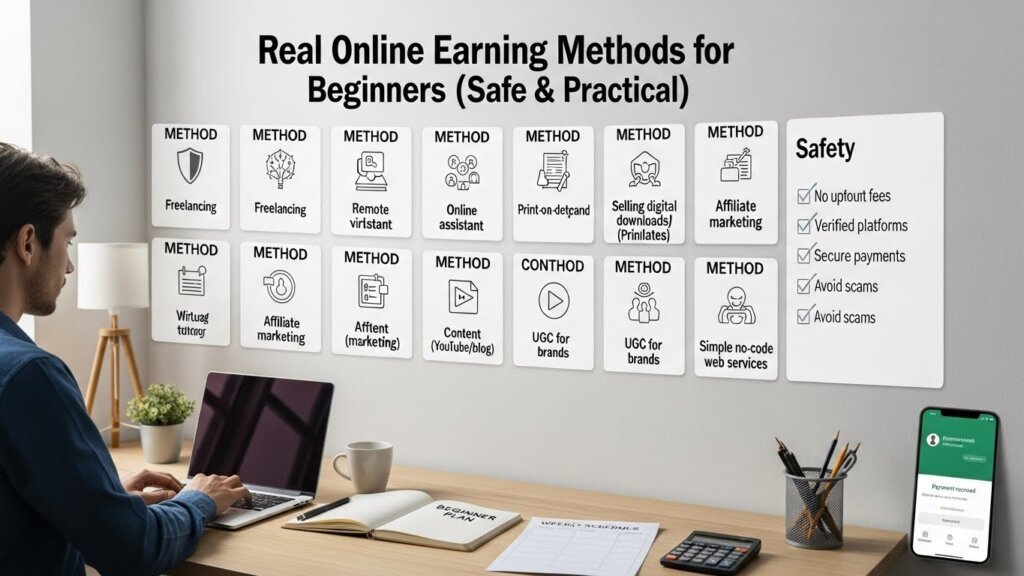
If you’re a beginner, online earning can help you:
- Earn side income without leaving home
- Learn modern skills (useful in jobs too)
- Build confidence
- Become independent (best feeling, honestly)
- Create a backup income stream
And a secret benefit: once you start earning even $500 online, your mind changes. You stop thinking “Can I?” and start thinking “How much more can I do?”
So tell me—if you earned your first $1 online, what would you buy? Or would you save it like a responsible adult? (Don’t worry, most of us do both: save 80%, treat 20%.)
Common Myths and Mistakes (Please read this, it’ll save you)
Myth 1: “Online earning is easy money”
It’s not “easy.” It’s simple, but it needs consistency.
Myth 2: “I need big investment”
Most beginner methods need zero money, just time + learning.
Myth 3: “I need to be expert first”
No. You can start small and improve while doing.
Myth 4: “I can earn $1 lakh in 10 days”
Some people can, but beginners usually can’t. If someone promises that easily, be careful.
Biggest beginner mistake: Trying 10 things at once
Today freelancing, tomorrow YouTube, next day crypto, then dropshipping… and in the end, nothing works because you didn’t stick long enough.
Pick one method for 30 days minimum.
Realistic Earning Potential (Honest, no hype)
Let’s be realistic.
In the first 30 days:
- Task-based methods: small money ($500–$5,000)
- Freelancing: possible $2,000–$20,000 (if you get clients)
- Content (blog/YouTube): usually $0–$5,000 (slow start)
In 3–6 months:
- Freelancing can become $15,000–$60,000/month
- Blogging/YouTube can start showing real growth (but depends on consistency)
- Affiliate income becomes possible if you build trust + traffic
In 1 year:
- Many people hit $50k–$1 lakh/month with skills + consistency
- Some earn more, but they treat it like a real business, not like a lottery ticket
Think of it like gym. You don’t get abs in 7 days. You get results after showing up regularly. (Also, if someone says “abs in 7 days,” they probably mean “add a filter.”)
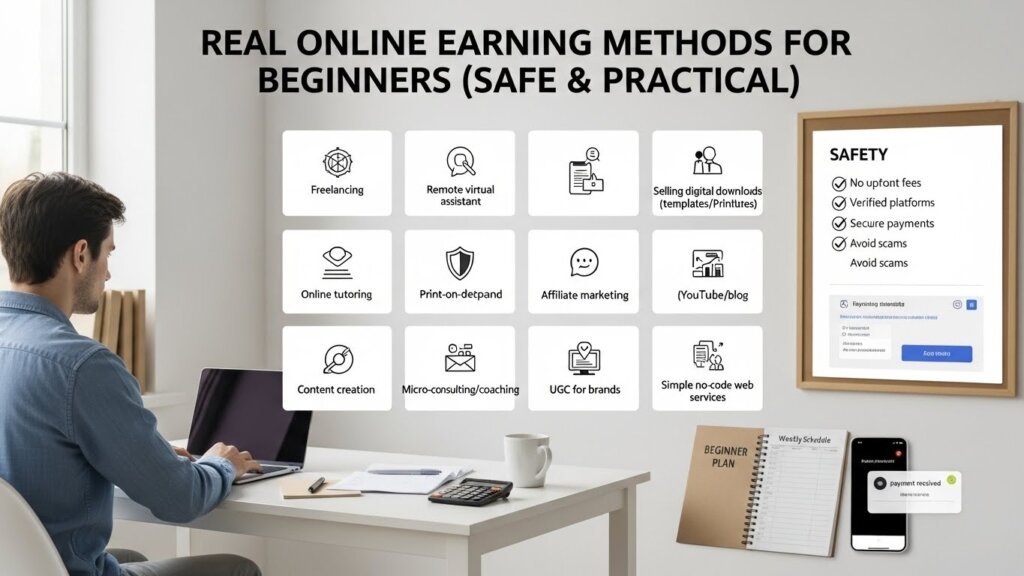
The Best Real Online Earning Methods for Beginners
Below are beginner-friendly options. I’ll explain what it is, how to start, and why it’s real.
1) Freelancing (Services you sell online)
Freelancing means you offer a service and clients pay you.
Beginner-friendly freelancing skills:
- Content writing
- Basic graphic design (Canva)
- Video editing (CapCut)
- Data entry (only if legit, beware scams)
- Social media management
- Translation (Hindi-English, etc.)
- Resume / CV writing
- Basic WordPress website setup
Where to start:
- Fiverr
- Upwork
- Freelancer
- PeoplePerHour
- LinkedIn (underrated)
Step-by-step (simple plan)
- Pick ONE skill (example: Canva posters)
- Make 5 sample designs
- Create profiles on 1–2 platforms
- Write a clean gig/service description
- Apply to 10 small projects daily for 2 weeks
- Deliver fast + ask for reviews
Real-life example
A beginner I know started making Instagram posts for local shops. First month: $3,000. Third month: $18,000. Same work, better speed, more clients.
Why it works: Businesses always need help. You solve a problem.
2) Online Tutoring (If you can teach even one subject)
If you can teach:
- Maths
- English
- Science
- Coding basics
- Spoken English
- Even handwriting practice for kids
You can earn.
Platforms:
- Chegg (availability varies by country)
- Preply
- Cambly (English conversation)
- UrbanPro (India)
- Superprof
- Local Facebook groups / WhatsApp communities
Beginner tip:
Start with 1 student. Just one. Give your best. Referrals will come.
Earning potential: $200–$1,000/hour depending on subject + level.
3) Content Writing (Very good for beginners)
If you can write simple English, you can start.
What you can write:
- Blog posts
- Product descriptions
- YouTube scripts
- Instagram captions
- Website pages (About, Services)
How to start:
- Pick a niche: health, finance basics, education, travel, tech, parenting
- Write 3 samples in Google Docs
- Create a LinkedIn profile + post your samples
- Pitch small businesses (email/DM)
- Join content writing internships (paid or stipend)
Tools that help (free/cheap):
- Grammarly (basic)
- Google Docs
- Hemingway Editor (readability)
Funny truth: Writing is one of the only jobs where people say “I can do it,” and then they see editing… and suddenly they remember they left the gas on.
4) Affiliate Marketing (Earn by recommending)
Affiliate marketing means you share a product link, and when someone buys, you get commission.
Good for beginners if:
- You can create content (blog/YouTube/Instagram)
- You can build trust
- You don’t spam links everywhere like “buy buy buy”
Platforms:
- Amazon Associates
- Flipkart Affiliate
- Digistore24 (digital products—choose carefully)
- ShareASale / CJ (brand affiliates)
Beginner-friendly way:
- Start a small blog or YouTube channel
- Make “best for beginners” content
- Use affiliate links naturally
Example topics:
- “Best budget headphones under $1000”
- “Best study lamp for students”
- “Best free apps for learning English”
Real talk: Affiliate is not instant. But once content ranks or gets views, it can become passive-ish.
5) YouTube (Slow start, strong long-term)
YouTube isn’t “easy money,” but it’s real and powerful.
Beginner-friendly channel ideas:
- Study tips
- Simple cooking
- Mobile app tutorials
- Motivational stories
- Product reviews
- Gaming (high competition but possible)
- Kids learning (be careful with policies)
How you earn:
- Ads (after eligibility)
- Affiliate links
- Sponsorships
- Your own digital product/service
Step-by-step for beginners:
- Pick one topic
- Make 10 videos before judging results
- Improve audio + thumbnail slowly
- Keep videos simple and helpful
Tip: You don’t need expensive camera. A phone + good light is enough.
6) Blogging (AdSense-friendly long-term method)
Blogging is one of the best real online earning methods for beginners who can stay consistent.
How blogs earn money:
- Google AdSense (ads)
- Affiliate marketing
- Sponsored posts
- Selling digital products (notes, templates, ebooks)
Simple blogging plan:
- Pick a niche: education, jobs, finance basics, health, recipes
- Buy domain + hosting (or start free, but serious growth needs your own site)
- Publish helpful articles consistently
- Learn basic SEO (not complicated)
- Monetize after traffic grows
Important: Blogging takes time. But it builds an asset.
7) Selling Digital Products (No stock, no delivery headache)
Digital products are things like:
- Resume templates
- Notion templates
- Excel trackers
- Study notes
- Canva templates
- Mini ebooks
Where to sell:
- Gumroad
- Payhip
- Etsy (for templates)
- Your own website
- Telegram/WhatsApp (with payment links)
Beginner approach:
Create one useful thing for one type of person.
Example: “Class 10 Maths formula PDF” or “Simple budget planner for students.”
8) Remote Jobs for Beginners (Yes, real jobs exist)
Some companies hire for:
- Customer support (chat/email)
- Data labeling (legit companies only)
- Virtual assistant tasks
- Content moderation (can be stressful)
- Sales support
Where to search:
- LinkedIn Jobs
- Indeed
- Internshala (India)
- Remote.co
- Wellfound (startups)
Safety note: Never pay for a job. Real employers don’t ask for “registration fees.”
9) Microtasks & Surveys (Only as a starter)
This is the “small earning” zone.
Examples:
- Surveys
- Testing apps
- Simple tasks
It’s real sometimes, but income is limited. Use it to earn your first small amount, not as your life plan.
If a site says “Earn $500/day by clicking ads,” run away. That’s not a job, that’s a trap wearing a fake moustache.
A Practical Step-by-Step Guide (Beginner roadmap)
If you’re confused and want a clear plan, follow this:
Step 1: Choose your path (pick ONE)
Pick based on what you like:
- If you like talking: Tutoring / YouTube
- If you like writing: Content writing / Blogging
- If you like design: Canva freelancing
- If you like organizing: Virtual assistant
Step 2: Learn for 7 days (not months)
YouTube + free courses are enough to start basics.
Goal: Learn only what you need to do a small job.
Step 3: Make 3–5 samples
No samples = no trust.
Examples:
- Writer: 3 blog posts
- Designer: 10 Instagram posts
- Video editor: 2 short edits
- Tutor: lesson plan + demo
Step 4: Create a simple profile
- One nice photo
- Clear bio: what you do + who you help
- Add samples (Google Drive/portfolio)
Step 5: Get your first client/student
Try:
- Freelancing platforms
- LinkedIn outreach
- Local businesses
- Friends of friends
Script idea (simple):
“Hi, I help small businesses with Instagram posts using Canva. I can make 5 posts for you as a starter. Want to see samples?”
Step 6: Deliver better than expected
Fast delivery + polite communication = repeat clients.
Step 7: Increase price slowly
Once you have reviews and confidence, increase your rates.
Tools and Platforms That Make Life Easier
Here are beginner-friendly tools (most are free):
For writing:
- Google Docs
- Grammarly (basic)
For design:
- Canva
For video:
- CapCut
- InShot
For communication:
- Gmail
- WhatsApp Business
- Zoom / Google Meet
For portfolios:
- Google Drive folder
- Notion page
- Simple WordPress site (later)
Tips to Succeed Faster (Without burning out)
1) Consistency beats talent
Even 45 minutes daily is enough if you do it every day.
2) Learn by doing
Don’t wait for perfection. Start small gigs.
3) Keep proofs/screenshots
Testimonials, before-after work, results—these help you get more clients.
4) Be honest about what you can do
If you don’t know something, say: “I’ll check and update you.”
Clients love honesty more than fake confidence.
5) Build one strong skill stack
Example:
- Writing + basic SEO
- Canva + Instagram captions
- Video editing + YouTube thumbnails
This makes you more valuable.
Beginner-Friendly Mistakes to Avoid (Please don’t do these)
1) Paying for “work from home” kits
Most are scams. Real work pays you, not the other way around.
2) Copying other people’s content
Google doesn’t like it. And it kills your credibility.
3) Spamming affiliate links
If you do this, people will avoid you like a “good morning” WhatsApp forward at 6 AM.
4) Quitting too early
Online earning needs momentum. Give it at least 30–60 days.
5) Ignoring basics: communication and deadlines
Skill matters, but reliability matters more.
Common Myths (Quick reality check)
- You don’t need “many followers” to start freelancing.
- You don’t need expensive laptop to start (phone works for many methods).
- You don’t need to be fluent in English. Simple English works.
- You do need patience, practice, and a little courage.
FAQs (SEO-Optimized)
1) What are the best real online earning methods for beginners with no investment?
Freelancing (writing/design/video), online tutoring, and content creation (YouTube/blogging) are some of the best no-investment or low-investment options. You mainly invest time and effort, not big money.
2) Can a beginner really earn money online from a mobile phone?
Yes, many beginners start using a phone: video editing on CapCut, Canva design, tutoring via Zoom, affiliate marketing via social media, and even managing pages. A laptop helps later, but it’s not mandatory on day one.
3) How much can a beginner realistically earn online per month?
It depends on method and consistency. Many beginners start with $1,000–$10,000/month, then grow to $20,000–$60,000/month in a few months with freelancing or tutoring. Content-based earning can take longer.
4) Which online earning method is the safest for beginners?
Skill-based methods like freelancing and tutoring are generally safest because you provide real value and get paid directly. Also, they don’t require you to pay fees to “unlock” earning.
5) Is affiliate marketing good for beginners?
Yes, but it works best when you have content and trust. If you start affiliate marketing without helpful content, it becomes spammy and results are weak. Combine it with a blog, YouTube, or Instagram page.
6) How do I avoid scams while searching for online earning work?
Avoid any “job” that asks for registration money, ID bank details unnecessarily, or promises huge earnings quickly. Use trusted platforms, verify company pages, and never share OTPs or sensitive info.
7) What skill should I learn first to earn online quickly?
For many beginners, these skills give faster results: content writing, Canva design, basic video editing, and tutoring. Choose based on what you enjoy, because consistency is easier when you like the work.
Final Conclusion (Real motivation, no drama)
Online earning is not a magic button. It’s a skill game.
If you start with one real method, learn a little daily, and keep showing up, you can genuinely build a small income stream—and later, a big one.
Don’t chase “overnight success.” Chase “daily progress.”
Pick one method from this list today. Just one. Take the first step, even if it’s small. Because one small step is better than 100 motivational videos.
If you want, you can treat this as your next action:
- Choose: freelancing / tutoring / YouTube / blogging
- Spend 45 minutes today learning basics
- Create your first sample
That’s how real online earning starts.
If You want To start make making money online then you can check these articles:
20 AI Tools for Online Earning Beginners (Simple Guide 2026)
Real Online Earning Methods for Beginners (Safe & Practical)
How to Earn Money Online With No Skills: A Real, Beginner-Friendly Guide
How to Make $12k–$15k Per Month in 2026 With AI and Digital Products (No Skills Required) 20 Small Business That You Can Start With AI in 2026 (Beginner-Friendly Ideas + Step-by-Step Guide)