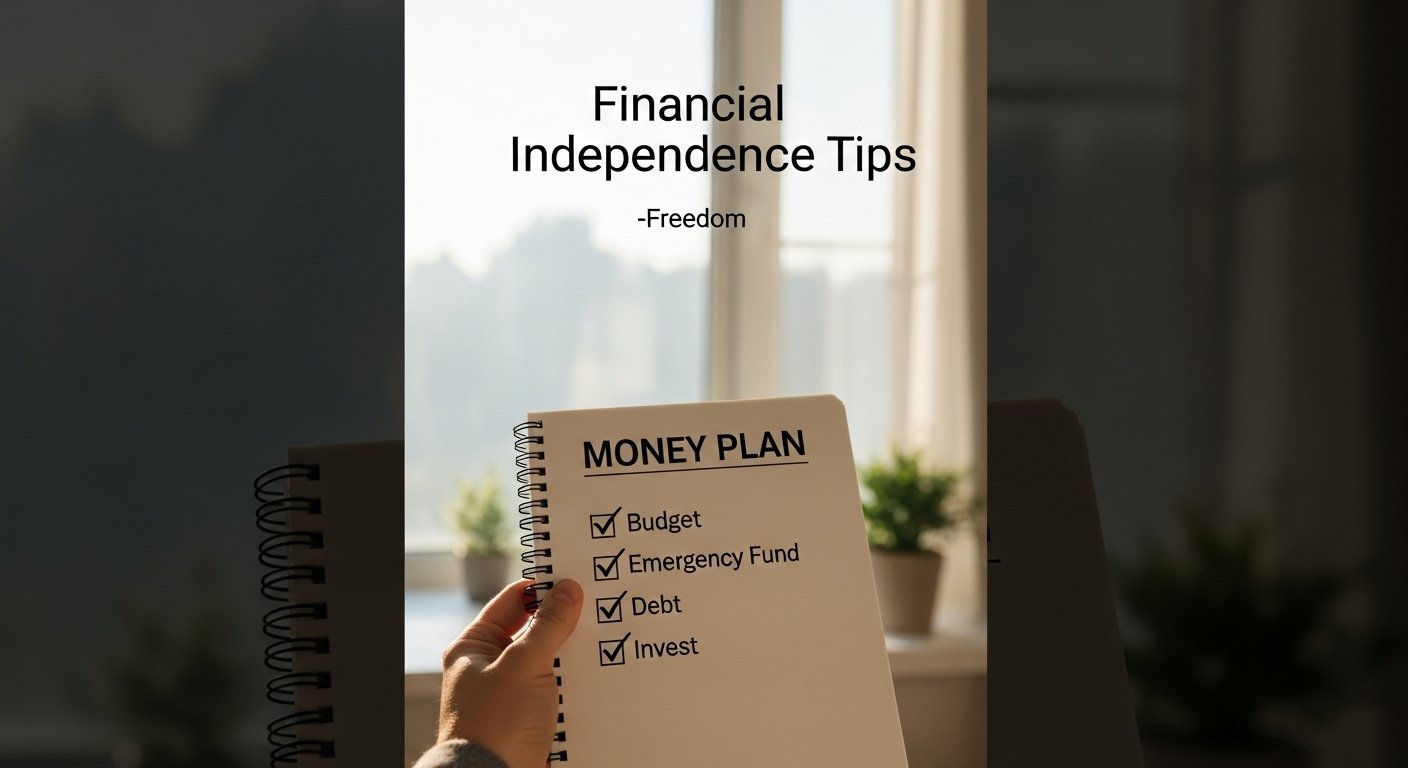
If you’ve ever thought, “I just want to stop worrying about money,” you’re not alone. Most people don’t actually want a mansion, a sports car, and a private island. They want something much simpler: choices. The choice to leave a stressful job. The choice to take a break when life gets heavy. The choice to help family without panicking about your bank balance.
That’s what financial independence is really about. It’s not about being rich rich. It’s about being steady, safe, and free enough that money doesn’t control every decision.
And yes, you can work toward it even if you’re starting from zero. Even if you’ve made money mistakes. Even if your paycheck feels like it disappears faster than ice cream on a hot day.
In this guide, I’ll share financial independence tips that are realistic, beginner-friendly, and written in simple English. No fancy jargon. No hype. Just steps you can actually do.
What Is Financial Independence Tips (And What Does Financial Independence Mean)?
Let’s keep this super simple.
Financial independence means you have enough money coming in without working a regular job, so you can cover your basic living costs. That money can come from investments, savings, rental income, a small business, or a mix of things.
Now, “financial independence tips” are the habits and steps that help you reach that point.
Here’s the big idea:
You work and save now so Future You can live with more freedom later.
Financial independence doesn’t mean you never work again. Many financially independent people still work, but they work because they want to, not because they have to.
Ask yourself this: if you didn’t need money, what would you do with your time?
That question is a great starting point because it helps you understand your real goals.
How Financial Independence Works (Step-by-Step, No Confusing Stuff)
Financial independence is not one magic trick. It’s more like building a house. You don’t start with the roof. You start with the foundation.
Here’s the basic step-by-step path:
1) You spend less than you earn
This is the engine. If you don’t have a gap between income and expenses, nothing else works long term.
2) You use the extra money wisely
Instead of letting it vanish into random shopping or takeout, you give it a job: paying debt, building savings, investing.
3) You build an emergency fund
This protects you from surprises like car repairs, medical bills, or job loss.
4) You pay off high-interest debt
Debt with high interest is like trying to run forward while someone holds your shirt.
5) You invest consistently
Investing is how your money starts working for you. Even small amounts matter when you’re consistent.
6) Your investments grow over time
This is where patience wins. Time is a powerful tool.
7) Eventually, your passive income can cover your living costs
That’s the finish line: your basic life is funded without you trading hours for dollars.
It’s not fast. It’s not flashy. It’s effective.
Why Beginners Should Care About Financial Independence
Some people hear “financial independence” and think it’s only for high earners. That’s a myth.
Beginners should care because financial independence is really about building safety and options. Here’s why it matters:
You’ll stress less about money
When you have savings, a plan, and fewer debts, life feels lighter.
You’ll handle emergencies without panic
A flat tire becomes an inconvenience, not a crisis.
You’ll be less trapped
A toxic job or bad boss feels different when you’ve got savings and investments.
You can help your family smarter
Instead of giving money and hoping, you can plan and support without wrecking your finances.
You can retire earlier or work fewer hours
Even if you don’t retire at 35, maybe you can retire at 55 instead of 70. That’s still a big win.
And honestly, the best part is confidence. You start trusting yourself with money. That feeling is priceless.
Common Myths and Mistakes (Let’s Clear the Noise)
There’s a lot of internet nonsense around money. Let’s clean it up.
Myth 1: You need a huge salary
A higher income helps, sure. But people with high income still go broke when they spend it all. Financial independence is more about the gap between what you earn and what you spend.
Myth 2: Investing is only for experts
Investing can be simple. Basic index funds exist for a reason. You don’t need to be a Wall Street genius. You just need a steady plan.
Myth 3: You must live like a monk
You don’t need to eat plain rice forever. You can enjoy life while saving. The goal is a balanced plan you can stick to.
Myth 4: Financial independence is “get rich quick”
Nope. It’s more like “get stable slowly.” Not as exciting, but much more real.
Myth 5: One side hustle will fix everything
Side income helps, but it doesn’t replace habits. If you earn extra and still spend everything, you’re just running faster on the same treadmill.
Now for common mistakes beginners make:
Spending without tracking
Not having an emergency fund
Keeping credit card debt while investing small amounts
Trying complicated investments too early
Comparing your timeline to someone else’s highlight reel
Here’s a simple truth: boring money habits beat exciting money plans.
Realistic Earning Potential (No Fake Hype)
Let’s be honest. Financial independence is possible, but it’s not a lottery ticket.
How fast you reach it depends on:
Your income
Your savings rate (how much you save)
Your living costs
Your investment returns
Your consistency and patience
Some people reach a strong level of freedom in 10 to 20 years. Some do it faster by earning more and keeping costs low. Some take longer because life happens, and that’s okay.
A realistic goal for a beginner might look like this:
Year 1: Build a small emergency fund, pay off a chunk of debt, start investing a little
Years 2 to 5: Increase savings, keep investing, grow income, reduce big expenses
Years 5 to 15: Investments start growing faster, lifestyle becomes more flexible
Years 10 to 25: Many people can reach full financial independence depending on choices
This is not a promise. It’s a normal range.
Also, investing returns are not guaranteed. Markets go up and down. That’s why you focus on what you can control: your savings, your spending, and your time in the market.
If someone tells you you’ll be financially independent in 3 months, they’re either selling something or they’ve confused financial independence with winning a game show.
Step-by-Step Practical Guide to Financial Independence (Beginner Version)
Let’s walk through a clear plan. You can start today, even if your bank account is currently playing hide and seek.
Step 1: Know Your “Why” and Pick a Simple Goal
Your “why” keeps you going when motivation fades.
Examples:
“I want to stop stressing about bills.”
“I want to leave my job in 10 years.”
“I want to work part-time and spend more time with my kids.”
“I want freedom to travel without debt.”
Now pick a simple goal for the next 30 days:
Save $200
Pay off one credit card
Track spending daily
Start investing $25 a week
Small goals build big momentum.
Step 2: Track Your Money (Without Making It a Big Drama)
You can’t improve what you don’t measure.
For one month, track:
Income
Bills
Food
Transport
Shopping
Subscriptions
Fun money
Most people find “leaks” fast.
Common leaks:
Unused subscriptions
Random online purchases
Convenience food
Impulse spending when bored
Here’s a tiny joke that’s also true: some subscriptions are like houseplants. You pay for them, forget them, and somehow they still exist.
Tracking doesn’t mean judging yourself. It means learning.
Step 3: Build a Simple Budget You Can Actually Follow
A budget isn’t a punishment. It’s a plan.
Try one of these beginner-friendly methods:
The 50/30/20 rule
50 percent needs (rent, bills, groceries)
30 percent wants (fun, eating out)
20 percent savings and debt payoff
If money is tight, you might do 70/20/10 at first. That’s okay.
The “pay yourself first” method
The moment you get paid, move a set amount to savings or investments. Then live on the rest.
The key is consistency, not perfection.
Step 4: Create Your Starter Emergency Fund
Start with $500 to $1,000 if you’re in debt. This prevents new debt when life throws surprises.
Then aim for 3 to 6 months of living expenses over time.
Where to keep it: a safe savings account where you can access it quickly.
This fund is not for shopping sales. It’s for real emergencies. If you use it for a new TV, your future self will not clap.
Step 5: Kill High-Interest Debt (Credit Cards First)
High-interest debt is one of the biggest blockers to financial freedom.
Two simple payoff methods:
Debt snowball
Pay smallest debt first for quick wins, then move to the next.
Debt avalanche
Pay highest interest first to save the most money over time.
Pick the one you’ll stick with. The best plan is the one you actually do.
Real-life example:
Let’s say you have a $2,000 credit card at 24 percent interest. Paying the minimum can keep you stuck for years. Paying even $100 extra per month can cut the timeline a lot.
Step 6: Start Investing Early (Even With Small Amounts)
Investing is how you build wealth over time. You don’t need a huge amount to start.
Beginner-friendly options often include:
Retirement accounts (like 401(k) or IRA, depending on your country)
Broad index funds
Target date funds
If your employer offers a match (like a 401(k) match), try to get it. It’s basically free money. And free money is everyone’s favorite kind of money.
Start small if you need to. $25 a week is still a start.
Step 7: Increase Your Income (Without Burning Out)
Cutting expenses has limits. Income growth can be more powerful long term.
Ideas to increase income:
Ask for a raise after you document your work results
Switch jobs strategically for better pay
Learn a high-value skill (basic tech skills, writing, sales, design, bookkeeping)
Start a side hustle you can manage on weekends
Keep it realistic. Don’t start five side hustles at once. That’s how people end up exhausted and eating cereal for dinner while staring at unfinished projects.
Pick one thing, do it well, and grow slowly.
Step 8: Lower Your Biggest Expenses (The “Big Three”)
Most budgets are controlled by three main costs:
Housing
Transportation
Food
If you want faster progress, look here first.
Housing: roommates, downsizing, moving when possible
Transportation: reliable used car, lower insurance, fewer upgrades
Food: meal planning, cooking simple meals, limiting takeout
You don’t need to cut joy. Just cut waste.
Step 9: Build Your Financial Independence Number
This is a simple way to estimate what you need.
A popular rule is the 4 percent rule, which suggests you might withdraw about 4 percent of your invested money per year in retirement.
To estimate:
Annual spending x 25 = rough FI number
Example:
If you spend $40,000 per year, your rough number is $1,000,000.
This is not perfect, and life changes, but it helps you plan.
Also, you don’t have to aim for full financial independence at first. Many people aim for:
Debt freedom
A full emergency fund
Coast FI (enough invested that you can slow down)
Barista FI (part-time work plus investments)
Progress comes in stages.
Tools, Platforms, and Methods That Help (Beginner-Friendly Picks)
You don’t need fancy tools, but the right ones make life easier.
Budgeting tools
A simple notebook (yes, it works)
A spreadsheet (Google Sheets is free)
Budgeting apps that connect to your bank (only if you’re comfortable)
Saving automation
Automatic transfers to savings
Automatic investing each payday
Automation is like setting a trap for your own money, but in a good way. It catches savings before you can spend it.
Investing platforms
Use reputable, regulated brokers in your country. Look for low fees and simple index fund options. If you’re not sure, start with your workplace retirement plan or a well-known provider.
Bill negotiation and expense trimming
Call your internet or phone provider and ask for a cheaper plan
Review insurance rates yearly
Cancel subscriptions you don’t use
Learning resources
Basic personal finance books for beginners
Free education from trusted financial websites
Podcasts that focus on long-term money habits
When you learn, keep it practical. You don’t need to memorize everything. You just need the next step.
Tips to Succeed Faster (Without Doing Anything Weird)
These financial independence tips can speed things up in a healthy way:
Make saving a default, not a decision
Automate savings and investing so you don’t rely on willpower.
Use “fun money” on purpose
Give yourself a small amount to enjoy. This keeps you from binge spending later.
Increase income in seasons
You don’t have to hustle forever. Do it in seasons: 6 months of focused effort, then stabilize.
Avoid lifestyle inflation
When you get a raise, don’t upgrade everything. Upgrade your savings rate first.
Build a “money meeting” habit
Once a week, spend 15 minutes reviewing your money. Quick check: what came in, what went out, what needs attention.
Find your big motivation
A picture of your dream life helps. Not the “luxury” dream. The real one. Maybe it’s peace, time, travel, or a home with a small garden.
Choose simple investments
Complex investments don’t always mean better returns. Often, they mean more fees and more stress.
Protect your time
Burnout ruins progress. Rest is part of the plan.
Here’s a funny line to remember: your budget shouldn’t make you cry into your sandwich. It should help you sleep better at night.
Beginner-Friendly Mistakes to Avoid (So You Don’t Learn the Hard Way)
Mistakes are normal, but some are expensive. Try to avoid these:
Waiting for the “perfect time”
Start with what you have. Perfect time is rare.
Trying to invest before you have a basic emergency fund
You don’t want to sell investments in a panic because your car broke down.
Falling for quick money promises
If someone guarantees big returns with “no risk,” that’s a red flag.
Ignoring insurance
Health, home, renters, and car insurance protect you from big financial hits.
Not understanding what you’re investing in
If you can’t explain it simply, pause and learn first.
Over-optimizing small things while ignoring big ones
Saving $2 on coffee is fine, but lowering rent by $200 matters more.
Comparing your beginning to someone else’s middle
Some people started earlier, inherited money, or had higher incomes. Focus on your lane.
Forgetting to enjoy the journey
If your whole life becomes “save, save, save,” you may quit. Build a plan you can live with.
FAQs About Financial Independence Tips
1) What are the best financial independence tips for beginners?
Start by tracking spending, building a small emergency fund, paying off high-interest debt, and investing a small amount consistently. Keep it simple and focus on habits you can repeat every month.
2) Can I become financially independent on a low income?
Yes, it’s possible, but it may take longer. The biggest keys are keeping living costs reasonable, avoiding high-interest debt, building job skills to increase income, and investing steadily over time.
3) How much should I save each month for financial independence?
A common starting point is 10 to 20 percent of your income, but any amount is useful. If you can only save 1 to 5 percent right now, start there and increase it when you can.
4) Should I pay off debt or invest first?
If the debt has high interest (like most credit cards), paying it off usually comes first. Many people do both by investing enough to get an employer match while focusing extra money on debt.
5) What is the fastest way to reach financial independence?
The fastest realistic way is a mix of increasing income, keeping lifestyle costs stable, and investing the difference. Extreme cutting can work short term, but steady habits usually work better long term.
6) How do I know my financial independence number?
Estimate your yearly spending and multiply it by 25 for a rough target. For example, if you spend $30,000 per year, your estimate is $750,000. This is a planning tool, not a perfect prediction.
7) Is financial independence the same as retiring early?
Not always. Financial independence means you could stop working if you want to. Retiring early is one option, but many people choose flexible work, passion projects, or part-time jobs instead.
Final Conclusion: You’re Not Behind, You’re Starting
Financial independence isn’t for perfect people. It’s for consistent people.
If you’re a beginner, your job isn’t to master everything today. Your job is to take one step, then another, then another. Track your spending for a week. Save your first $100. Pay extra on one debt. Open an investing account when you’re ready. Keep going.
Some months will be smooth. Some months will be messy. That’s normal. Progress still counts, even when it’s slow.
You’re building a life where money doesn’t control your choices. And that kind of freedom is worth the effort.
Now tell me this: what’s the first small step you can take this week to move closer to financial independence?